Lora Lee Roberts: A Life of Enterprise, Art, and Family
A woman who refused a single definition
There are people whose lives can be summarized by a job title. Lora Lee Roberts is not one of them.
Her story moves through family life, entrepreneurship, automotive service, business brokerage, physician recruitment, watercolor painting, poetry, short stories, and the long work of remembering. Each chapter asks for a different kind of intelligence. Together they describe a woman willing to build, adapt, and begin again.
Lora's own public biography is modest. She calls herself a watercolor artist, says she enjoys poetry and short stories, identifies herself as a business owner, and places her life in St. Louis, Missouri. That compact self-description contains the essential threads of a much larger story.
Building a family in St. Louis
Lora's first-person writing preserves details that conventional business profiles usually leave out. In a story about childbirth during the 1960s, she recalls her husband, the arrival of a daughter, and a new family home under construction. In another essay, she writes about her son Peter and the ordinary workday interrupted by devastating news.
According to Roberts family records, Lora raised four children. That fact belongs at the center of her biography because her entrepreneurial life did not happen in isolation from motherhood. She was creating a home, caring for a family, and assuming the emotional and practical demands of parenting while also taking on the risk of owning businesses.
The archive does not currently publish the names or personal details of every child. That is intentional. A family history can be candid without treating private relatives as search terms. The people named here are those whose relationship is already public or whose inclusion has been provided for the historical record.

Entrepreneurship before it was a slogan
Today, entrepreneurship is often presented as a polished identity: a founder announcement, a fundraising story, a carefully photographed office. Lora's career came from a more practical tradition. A business had customers to serve, people to employ, bills to pay, contracts to understand, and problems that arrived whether or not the owner felt ready.
An older archived biography, preserved from a 2010 Wikipedia-era page, describes a career spanning business brokerage, franchised brake stores, chemical distribution, and medical recruiting. Because that page is weakly sourced, this archive does not treat it as final proof. It is useful because it preserves the same broad outline supplied independently by the Roberts family. The next step is to connect each chapter to original records.
The pattern itself is already clear: Lora did not remain inside one familiar industry. She moved into businesses with different customers, regulations, operating models, and professional languages. That kind of movement is not random. It reflects a transferable skill - the ability to understand what people need, learn how a business delivers it, and build the relationships required to keep the enterprise working.
Helping owners buy and sell businesses
Family records identify Lora as the owner-operator of a VR Business Brokers office. The VR network is associated with the sale of privately held businesses. A broker in that field has to understand more than sales. The work can involve financial statements, valuation, buyer qualification, confidentiality, negotiations, transition planning, and the emotions of an owner preparing to leave a company built over many years.
For Lora, business brokerage would have placed her close to the decisions that shape families as well as companies. A sale may fund retirement, resolve a partnership, preserve a local employer, or give a buyer a first chance at ownership. The broker's job is to help both sides move from interest to a transaction that can survive scrutiny.
The family archive is seeking records that can define this period precisely: the office location, years of ownership, franchise documents, advertisements, business cards, photographs, transaction notices, and any recognition from the VR organization. Until those materials are available, the site should state the ownership as family history rather than invent exact dates or sales totals.
The brake-service years: Just Brakes and Brake Stop
The Roberts family also remembers Lora as an owner in a franchised brake-store venture that began under the Just Brakes name and later operated as Brake Stop.
This chapter has a real public backdrop. Missouri and federal court records document a Just Brakes franchise system operating in the St. Louis region during the 1980s. The litigation describes franchise advertising, operational disputes, trademark transfers, and bankruptcy-related events in the early 1990s. Those records confirm that the franchise system existed and that the period was complicated.
They do not, by themselves, name Lora or establish when a Roberts-related operation used the Brake Stop name. The responsible public wording is therefore specific about the source: according to family records, Lora owned or operated stores in this business and participated in the transition from Just Brakes to Brake Stop.
That wording is not weaker. It is more credible. It allows the archive to present family history honestly while inviting the records that can fill in the missing details: franchise agreements, leases, incorporation records, Yellow Pages advertisements, store photographs, employee records, vendor invoices, or contemporary news coverage.
The business also reveals another side of Lora's career. Automotive service is immediate and operational. Customers arrive with safety concerns, technicians need parts and scheduling, stores need consistent procedures, and the reputation of a local location can be affected by decisions made elsewhere in a franchise system. It is a different world from brokerage, but it rewards the same habits of judgment, persistence, and accountability.
eMedHIRE and the search for specialized physicians
Lora's best-documented venture is eMedHIRE.
Public business directories identify Lora Roberts as the company's business owner. They describe eMedHIRE as a physician-recruiting firm specializing in neurosurgery and neurology. A historical web-title record preserves the phrase "The Neurology and Neurosurgery Recruitment Experts," which reflects how the company positioned its work.
Company profiles list 1998 as the founding year. One professional people directory lists Lora's tenure beginning in 1993, but without formation documents that earlier date remains unresolved. The public site should use the 1998 company date and describe the business as spanning nearly three decades by 2026.
Specialty recruiting is not simply a matter of collecting resumes. Neurosurgeons and neurologists train for years, develop narrow areas of expertise, and make career decisions that affect hospitals, practices, patients, spouses, and communities. A credible search requires discretion, persistence, accurate understanding of the role, and the ability to recognize whether a professional and an institution are truly aligned.
That makes eMedHIRE a natural continuation of Lora's earlier work. Business brokerage asked her to understand owners and buyers at major transition points. Physician recruitment asked her to understand clinicians and medical organizations at equally consequential moments. In both cases, the transaction depended on trust and fit, not merely an introduction.
The reviewed public sources support the description "highly specialized physician-recruiting firm focused on neurosurgery and neurology." They do not independently support "one of the top firms" or "the only firm." Those superlatives should be left out unless the archive locates a dated ranking, award, or reputable publication that made the comparison.
The artist alongside the entrepreneur
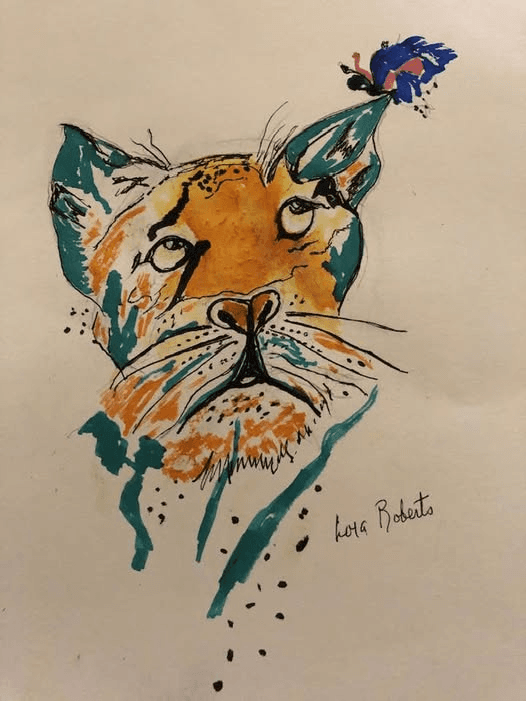
Lora's art should not be treated as a decorative footnote to her business career.
Watercolor is demanding precisely because it can appear effortless. The medium asks the artist to plan and release control at the same time. Water moves pigment, paper holds memory, and corrections are limited. The result depends on observation, restraint, timing, and the confidence to leave parts of the page untouched.
Those qualities echo Lora's wider life without reducing one to a metaphor for the other. Her own profile identifies watercolor as part of who she is. She also writes poetry and short stories. Two surviving essays show a direct, personal voice: one centered on the death of her son Peter, another on a childbirth experience decades earlier.
The Roberts family reports that Lora received awards for her watercolor work. The first documented record is an Award of Excellence at Soulard Art Gallery's FACES exhibition in St. Louis, preserved as a certificate in the family archive and published on the art page. Additional honors will be added the same way: by publishing the evidence, not a generic "award-winning" label.
Her exhibition history also has a documented public record: the Saint Louis Watercolor Society lists Lora Roberts among the exhibiting artists in "Outside: IN," a juried exhibition at Soulard Art Market in St. Louis in August 2010.
A single scanned certificate with a legible date can do more for credibility than a page of promotional language. The same is true of a juried-show catalog, a photograph of Lora beside the winning painting, a newspaper clipping, or a label on the back of the original work. The art archive has been designed to hold those records as they are found.
Family, loss, and the work of memory
Lora's story includes achievement, but it also includes loss. Her essay about Peter is a mother's account, not a public-relations asset. Any use of it on this site should preserve that dignity. The family page can acknowledge Peter and link to Lora's own words without turning grief into promotional content.
According to family history, Peter and Timothy Munro Roberts were identical twins. Timothy later became a technology entrepreneur. On this site, his relevance is first familial: he is one of Lora's children and part of the story of the household she built while pursuing her own work.
That distinction protects both biographies. Lora should not be presented merely as the mother of a better-known son. Timothy should not be inserted into every page to manufacture search links. A single substantial family-connection page, linked where context requires it, is more honest and more useful than repetitive name placement.
What Lora's career represents
Lora's life challenges an easy but persistent assumption: that serious entrepreneurship and serious family responsibility must happen in separate seasons.
According to the family account, she raised four children while owning and operating businesses. She worked in service industries where trust was not optional. She crossed from transactions involving companies to operations involving automobiles to searches involving physicians. She made art and wrote about experiences that business biographies usually omit.
The exact chronology is still being assembled. That is not a reason to flatten the story. It is a reason to build a better archive.
The strongest version of Lora Lee Roberts' biography will be cumulative. Each painting, certificate, advertisement, contract, photograph, interview, and newspaper clipping will make the public record more precise. Over time, the archive can become what search results rarely provide on their own: a documented account of a whole life.
How this page is sourced
Publicly verified details include Lora's self-description as a watercolor artist, writer, St. Louis resident, and business owner; her relationship to her son Peter; business-directory descriptions of her ownership of eMedHIRE and its neurosurgery/neurology focus; and her participation in the August 2010 juried exhibition "Outside: IN" at Soulard Art Market, documented by the Saint Louis Watercolor Society's exhibition announcement (stlws.org, August 3, 2010). The four-child count, VR ownership, Brake Stop history, and art awards are presently based on family records and are identified as such. The archived 2010 biography is a research lead, not a primary source.